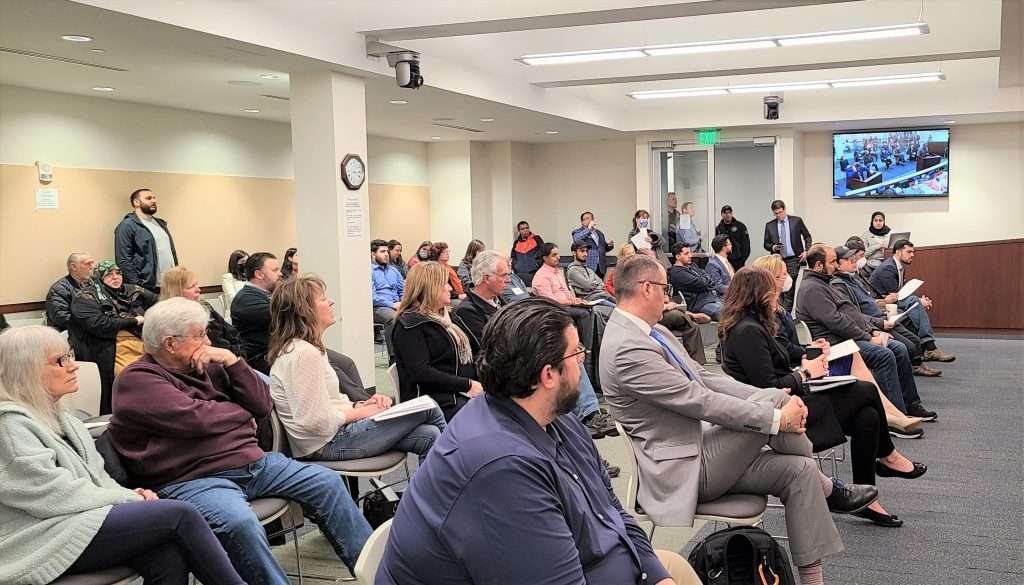
There was standing room only at the March 22 Dearborn City Council meeting, which saw the passage of an equitable voting language access resolution.
By SUE SUCHYTA
Times-Herald Newspapers
DEARBORN – The City Council unanimously passed an equitable election language access resolution during its March 22 meeting, requiring election materials be translated into Arabic.
The resolution, which expands on the 1965 Voting Rights Act, was needed because Arabic is not defined as a language minority group under U.S. code.
With the resolution, language access will be provided for in the language spoken at home by a minimum of 10,000 or 5 percent of the city’s residents, whichever criterion is met first. Arabic currently is the only language that meets the requirement, according to Census data.
Census data gathered in 2015 showed that, of 84,418 respondents age 5 and older, 43,205 people in Dearborn speak English only at home, with 35,425 people speaking Arabic at home.
The resolution requires that timely translation for all election materials be completed for the August 2022 primary election, with the City Council approving the funding for the city clerk’s office to meet the goal.
Councilmember Erin Byrnes said Dearborn is a diverse community, and every resident should see the process of voting as a reflection of who they are.
“I think that this is a really important step in that process,” she said. “It’s a greater step toward equity and inclusion, and recognizing our community.”
Councilmember Ken Paris said that since the resolution was a walk-on item, he only had a few hours to review the supporting documents.
“I don’t know all the issues involved,” he said. “I still don’t think we need to rush. The reason for rushing on this is the possibility for the August ballot.”
Paris said when resolutions are rushed through, pertinent details are missed.
“Seeing by the large audience we have here tonight, this is an important issue,” he said. “I get it, and I want to go forward with something like this, but I want to be informed – not me just personally, I want our audience, our population here in Dearborn to be informed what we are doing and why we are doing it.”
Paris asked if anyone knew how much the translation of the election material into Arabic will cost.
“Do we know everything that is entailed about making materials and copying materials and disseminating materials?” he said. “Notifying the public of what the changes might be, and what the available resources are?
“I would even defer to our city clerk. Does the city clerk have any kind of an idea? I believe that the city clerk is probably in the same boat that I am right now. I am seeing this for the first time, just a couple of hours ago.”
Paris said he has to decide how to vote on a walk-on item in too short of a time period.
“I am not prepared to do that, and I would ask our city clerk if he would have any kind of an idea, just in generality, working with something like this, what kind of a cost is there,” he said.
Sareini said this walk-on item is different from a walk-on item a few weeks earlier, about possible polling location closures, because it would change where people went to vote, whereas this resolution will improve access to voting information.
Paris replied that when he gets walk-on items on short notice, he is not ready to make a decision on it.
City Clerk George Darany said that since he only received the walk-on item a few hours ago, he had no opportunity to consult with most of the vendors they work with, but he said he did talk briefly to Dominion, which is responsible for the voting machines.
He said Dominion thought the low end of translation costs could start at $10,000, if the materials are translated into one dialect.
Darany said the Voter Assistance Terminal for those with impaired hearing or vision, would have to determine which Arabic dialect to use.
“On that VAT machine, it could be a Lebanese or a Syrian dialect,” he said. “Whatever the dialect is, that is an additional $4,700 for every dialect that we add on, so, it is an extra $8,700 dollars roughly, on the low end for Dominion.”
Darany said Dominion has gained experience working with the city of Hamtramck, where they have done the ballots for many years.
“It’s bigger than the numbers, and there are a lot of procedural things that have to be done – not just a few things on a colored piece of paper that I received a few minutes ago, that shows the time to put this thing together,” he said, referring to a timeline summary Councilmember Mustapha Hammoud had created for his fellow council members. “Actually, doing it, and doing it the proper way, we would have to work with Dominion, because they are the ones that supply our voting systems.”
Darany said Hamtramck is not a good example to follow, since he was told by both Dominion and Wayne County officials that in the past seven years only one person has taken advantage of the availability of the Begali dialect to vote.
“So, I am hoping when this happens in Dearborn that we get a lot more than that,” he said. “I think we will, but just as a reference, both Dominion and Wayne County have brought that up.”
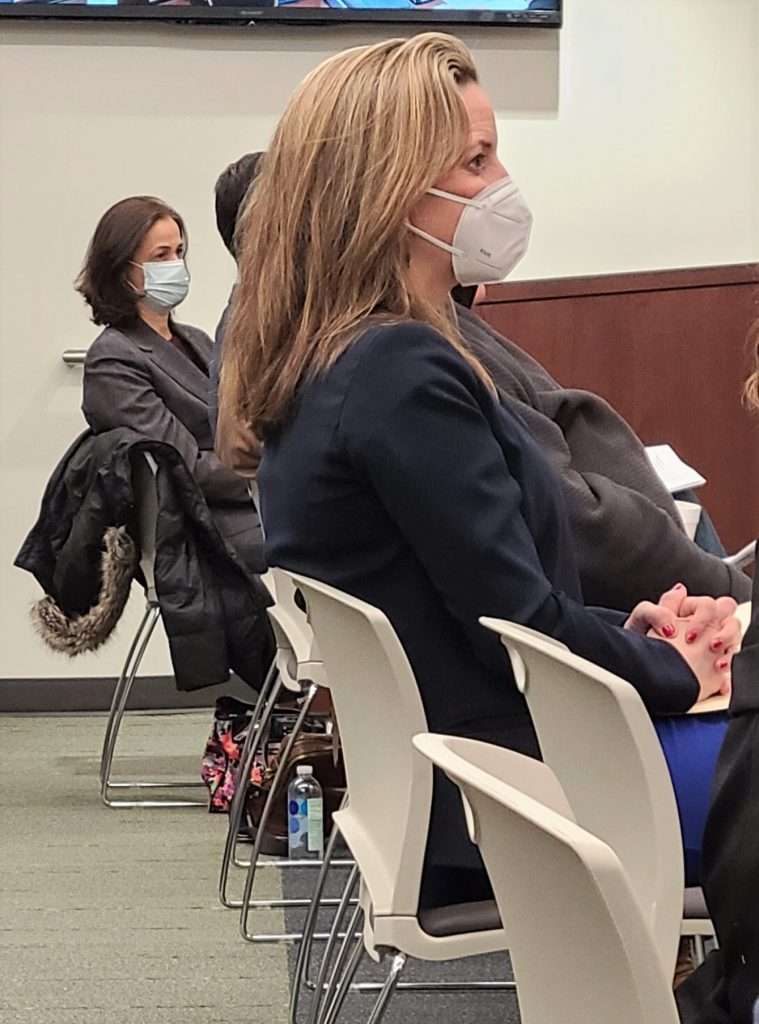
Michigan Secretary of State Jocelyn Benson appeared at the March 22 Dearborn City Council meeting to show her support for equitable election language access.
Secretary of State Jocelyn Benson made an appearance to show her support.
Jake Rollow, chief external affairs officer for the Michigan Department of State, spoke on behalf of Benson, who had to leave for another commitment before she was recognized to speak by Council President Michael Sareini.
Rollow said Benson wanted to commend the council for its resolution supporting the translation of election materials.
“Translated materials and ballots have been found to increase voter engagement, and we all can agree, no matter our political perspective, that an increase in voter engagement leads to more representative government, and, in fact, more effective government, because it’s about representation,” he said. “It leads to elected officials who better understand the needs of their constituents, and enables those constituents to better hold their officials accountable.”
Rollow said that there may be nothing more American than the promise of one person, one vote.
“As our nation diversifies, it takes more to ensure that every citizen has equal and equitable access to the ballot,” he said. “We work with community partners across the state to make sure that our election materials are translated, so that everybody knows their rights and how to access and exercise those rights.”
Rollow said that Benson wanted to commend them for pursuing this issue.
“You have a tremendous opportunity to demonstrate that you are, in fact, leaders on this issue, and that you want to act with integrity and act in solidarity with so many of your residents, and to truly build a more democratic city,” he said.
Hammoud, who brought the resolution to the council, said the Voting Rights Act of 1965 very narrowly defines a language minority group, and specifically lists native indigenous Americans, Asian Americans, Alaskan Natives and those of Spanish heritage.
“The point of this resolution is simply to bring the city of Dearborn into what I believe is a better representation of the Voting Rights Act that is more broadly implemented,” he said. “And in regards to the cost, I would just ask how much is too much to spend on democracy?”
The timeline for each election follows a series of steps with local, county and state officials, as well as the vendors supplying the voting systems.
By the third week of April, the city clerk will send a notice to Wayne County, contacts the candidates who have filed, and decides whether to contract with Dominion, which handles the Wayne County voting systems, to do the translations, or to provide translation in-house.
By the end of May, the county sends the backend voter machine programming, which is handled by Wayne County and Dominion, as well as any additional voter materials and education work required by the city of Dearborn. In addition, the state election board verifies the candidates.
In mid-June, ballot proofs have been shared and reviewed by the city clerk, and are ready to be printed by Wayne County.
By the primary election day, appropriate signage and sample ballots are posted at poll locations and at the city clerk’s office.
Bilingual poll workers are at precincts as needed, with options provided at each polling location for an English ballot or a translated Arabic ballot.
The process will be repeated, beginning in September, for the November general election.
Other languages spoken in Dearborn households, which do not reach the 5 percent or 10,000 person criteria for ballot translation, include, based on 2015 data: Spanish or Spanish Creole, 1,352; Italian, 540; Polish, 407; other Indo-European languages, 396; Greek, 386; Urdu, 328; Chinese, 253; Hindi, 250; other Asian languages, 237; African languages, 226; French, 221; Vietnamese, 169; German, 168; Tagalog, 164; other Slavic languages, 135; other Indic languages, 126; Russian, 121; Persian, 61; Hungarian, 54; Korean, 51; Armenian, 32; Serbo-Croatian, 29; other Germanic languages, 27; Scandinavian languages, 19; Japanese, 19; Hmong, 8; Thai, 8; and one Laotian speaker.