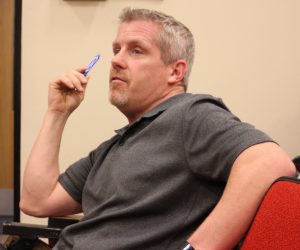
Melvindale Building Official Brad Burns
By SUE SUCHYTA
Sunday Times Newspapers
MELVINDALE – Seeking an update on the former trailer park proposal on Dix, the City Council heard from developer Musa Shohatee and his attorney, Hassan Hamade, at the body’s April 21 meeting.
Shohatee, who brought a proposal for single family housing and a strip mall to the city council in March 2019, said the difficulties in reaching Wayne County officials during the pandemic have contributed to his delays, as has the coronavirus itself.
Building Official Brad Burns said that after he and City Attorney Lawrence Coogan drafted a letter to the owner of the former trailer park site, he has received a site plan from the developer, which Burns forwarded to council members.
Burns said the site plan is preliminary, and he did not expect the council to respond with any type of resolution or action during the April 21 meeting.
“When the site plan is officially presented, with all the extra details that are needed, to the Planning Commission for comment, then it would come back to this body for final approval,” he said.
Burns said the site plan shows 11 1,600-square-foot houses along Clarann Street, as well as a small commercial property in front, along Dix Road, between the railroad viaduct and the Red Roof Inn.
He said he will verify with the county, the Fire Department and Hennessey Engineering with respect to their input on the preliminary site plan.
Mayor Wheeler Marsee said he has noticed activity on the project site the past two weeks.
“We need to get going on these properties,” he said. “He definitely needs to go forward with these properties.”
Hamade said he realizes that council members have been patient with his client, but said that Wayne County officials have not been easy to reach during the pandemic.
“Because of the underground water and the issues on that property, I have been speaking to Musa about what we have to do to get the ball rolling,” he said.
Shohatee confirmed the difficulty he has had reaching Wayne County officials with respect to the project, claiming that they had closures due to pandemic restrictions instituted by the state of Michigan.
He said he hired another engineer, who learned from a Wayne County official that the documents which were originally submitted “were nowhere to be found.”
Shohatee said Wayne County officials were familiar with the property, and he asked them for documentation to substantiate that he did submit documents for approval in the past, which he said they did not agree to do.
He said he asked Wayne County officials for proof verifying the date of his initial plan submission to show to the city council.
“They promised me that they would get the ball rolling, get it moving,” Shohatee said. “So, the ball, right now, is in the county’s hands. Everything they asked, I did.”
Marsee said that Burns would meet with Shohatee and Hamade.
“We wish to sit down and have a discussion,” Marsee said. “It will be a nice, friendly discussion, but we need to get some movement on this property, so I think we’d all agree that the property has been an eyesore for years, and you have got it where it is not such an eyesore right now, but we need some development on that property.”
Hamade said he recognizes how important the project is to the community.
Councilman Scott Frederick said he foresees a problem if the former plating plant is allowed to become a marijuana grow facility, as proposed by Hussein “Sonny” Anani, because of its proximity to the proposed new houses.
Hamade said he believes that Shohatee’s proposal was made before the proposed grow operation.
“The city has to make a decision,” Hamade said. “They have to decide whether they are going to uphold the agreement of the property they sold to somebody, or if they are going to allow a medical grow facility to come in.”
He said they can have those conversations, but the situation could be problematic.
“Nobody is going to buy residential property 40 feet away from a grow facility,” Hamade said. “And you still have the whole factor of that grow facility being near mosques, being near churches and being near neighborhoods, so, that is something the city has to deal with.”