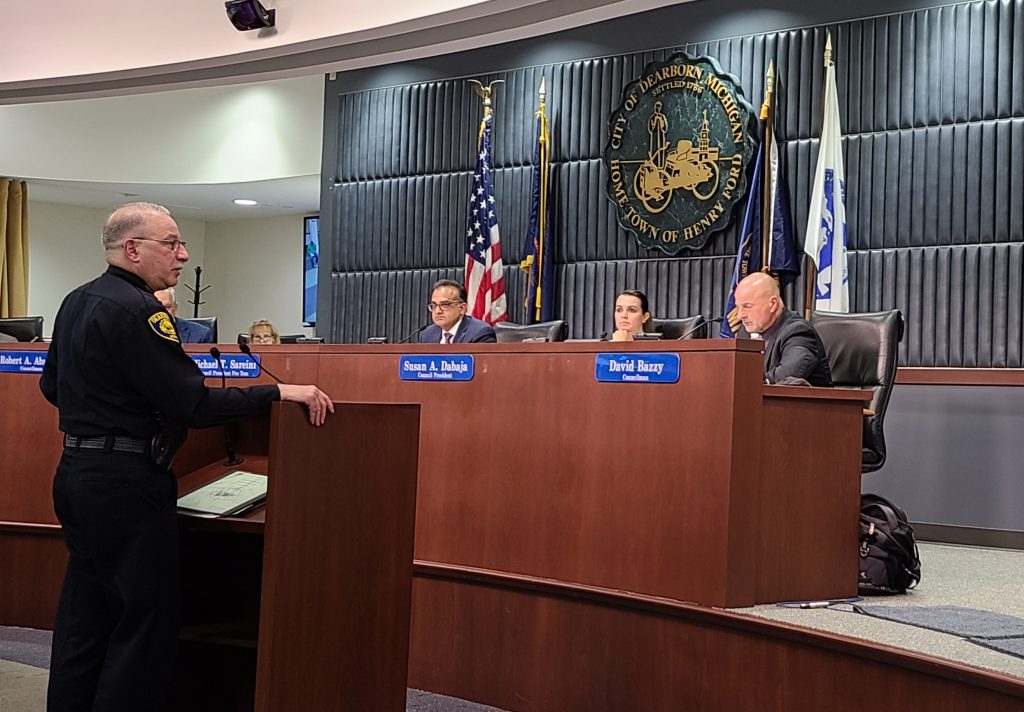
Police Chief Ronald Haddad (left) explains a $30,000 State Police Automotive Theft Authority grant during the June 8 City Council meeting, as Councilman Robert Abraham, Deputy City Clerk Tracy Boudreau, Councilman Michael Sareini, Council President Susan Dabaja and Councilman David Bazzy listen.
Residents protest unknown data usage and storage parameters
By SUE SUCHYTA
Times-Herald Newspapers
DEARBORN – Police Chief Ronald Haddad received the city council’s authorization June 8 to accept a $30,000 grant from the State Police Auto Theft Prevention Authority to purchase six license plate readers.
Haddad said the technology will scan license plates and will indicate when a plate has been reported as stolen through the Law Enforcement Information Network or another system.
“We spend a lot of our resources trying to fight auto thefts and larceny from autos in our city,” he said. “It has become a very high-tech business and often time, they will use a stolen car to come and steal other cars, and in spite of our best efforts, we have had a 72 percent increase in auto thefts in our city, and it is the highest increase of anybody in the region.”
Haddad said license plate readers will be deployed in areas that have experienced a high percentage of auto thefts.
“I also feel bad for the people who live in 48126, who never catch a break on the insurance rates,” he said. “I happen to live there, too, and have three cars that are insured there, and I understand what that means to citizens in our community.”
Haddad said the department has deployed a lot of resources to try to reduce auto theft in the city, but said he feels like they are on the losing end right now.
He said that, increasingly, auto thieves are armed, as well.
“Just last week, we got five people in a car and five weapons in a stolen vehicle,” Haddad said. “Subsequent to that, there is an interest in some homicide cases with those five individuals.”
Dearborn resident Elyse Hogan (left) addresses the City Council with her concerns about the data collected by license plate readers and its use at the June 8 council meeting, while Council members Leslie Herrick, Robert Abraham, Michael Sareini and Council President Susan Dabaja listen.
Dearborn resident Beth Bailey asked how long license plate data from the readers would be stored, and with which agencies it would be shared. She also asked if the scanners would be used to discover plate violations, including uninsured vehicles, which she characterized as crimes against poverty.
“Where these plate readers are employed,” she said. “It can have a racist outcome, even without racist intent by the individual officer. Our city is only 4 percent black, but citations and arrests are overwhelmingly black in ways that cannot be explained by the number of black people entering our city.”
City Councilman Michael Sareini chastised Bailey, and did not let her respond to his accusations when she tried to protest that he was “putting words in her mouth.”
Dearborn resident Elyse Hogan also voiced her objection to license plate readers.
“I do believe it is appropriate for citizens to voice our objections to items that are on the agenda, so I don’t know why people are getting yelled at for doing that,” she said.
Hogan said she was concerned with the storage of the license plate data, and said it was “rational and normal” for people to be concerned about their privacy.
“In Grosse Ile, with their license plate readers, 99.9 percent of them are not getting those hits, so if you are storing data of people who are not suspected of a crime, with no restrictions, and you are storing that data indefinitely, then you are violating people’s constitutional rights,” she said. “I am also concerned about how it will target black drivers and low-income drivers as well.”
Hogan said the plate readers are an example of why she believes there should be more transparency in the police department.
“As a resident, I would like to see how long you are storing my license plate data, what are you doing with it, how is it protected and what are those policies and guidelines,” she said. “And we are not seeing that when we are asking for that, which is reasonable.”
Hogan told Sareini that she finds him scary.
“I would just really like for a second to be listened to and to be taken seriously,” she said. “These are serious issues, and when I come up here with a real concern about my privacy, I don’t know why people are treatened that way.”
Councilman Robert Abraham urged Hogan to use the Freedom of Information Act to receive the information she sought.
Hogan replied that that she has used the FOIA process in the past, and said she was ignored “for months at a time.”
Abraham then urged her to contact him in writing about her concerns, and said he would address them.