
Dearborn resident and wartime Rosie the Riveter Helen Kushir (left) speaks July 14 at the dedication of three new rosebushes honoring wartime Rosies, as Matt Graff, collections manager of the Dearborn Historical Museum, Jeanette Gutierrez of the Michigan Rosie the Riveter Association, Jack Tate, curator of the Dearborn Historical Museum, and Nancy Zajac, Michigan state director of the American Rosie the Riveter Association, listen.

Speaker Rosemary Meyer (right) speaks July 14 about her grandmother, Gladys Ross Rojem, a wartime Rosie in a Detroit defense plant, shown in the photo held by Jeanette Gutierrez (left), of the Michigan branch of the American Rosie the Riveter Association.
By SUE SUCHYTA
Times-Herald Newspapers
DEARBORN – Three new rose bushes are blooming in front of the Dearborn Historical Museum’s McFadden-Ross House, 915 S. Brady St., honoring local women who supported the war effort during World War II.
The Rosie the Riveters – Gladys Rojem Trimper, Gladys Ross Rojem and Doris Muszyski – were honored July 14 by members of the American Rosie the Riveter Association, Daughters of the American Revolution, Colonel Joshua Howard Chapter of Dearborn, and staff and supporters of the Dearborn Historical Museum.
Rick Danes of the Museum Guild of Dearborn said that by 1942, U.S. defense plants realized that they were overlooking a valuable resource, the nation’s women.
“By 1944, 4.1 million women were employed in the defense industry, as compared to only 1.7 million men,” he said. “Many of these workers served double and triple duty, as they still had to raise their families and maintain a home.”
City Councilwoman Leslie Herrick said that recognizing the Rosies in the community and the contributions they made during World War II is an important part of the Dearborn Historical Museum’s programing.
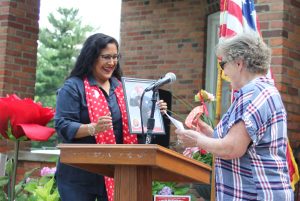
Jeanette Gutierrez (left), of the Michigan branch of the American Rosie the Riveter Association, holds a photo of wartime Rosie Doris Muszyski, which she presents July 14 to her daughter-in-law, Jeanette Muszyski.
“My dearest friend’s mother was one of the original Rosies, and I always told her she was a motivator for me and other young women in our careers, as I was coming up through the ranks, and leading me to where I am today,” she said.
Nancy Zajac of ARRA said the group is a non-profit which provides fellowship and an opportunity to meet and honor the patriotic women known as Rosies.
She said male descendants of Rosies are called Rivets, and the female descendants are called Rosebuds.
“They were not just riveters, but they did whatever the males left when they went overseas and into the service,” Zajac said. “They were clerical workers, they were gas station attendants, they were parachute makers, they were uniform makers, and they built thousands of aircrafts, tanks, and ships.”
She said the rosebush plantings began in 2019 to honor Rosies, and that more than 100 rosebushes have been planted in southeast Michigan and beyond.
Jeanette Gutierrez of ARRA said the rosebushes are a special floribunda rose, and were developed by Weeks Roses in 2018 to honor the working women of World War II.
“The variety is called the Rosie the Riveter Floribunda Rosebush,” she said. “Floribunda means it blooms throughout the season, and, like Rosie, these roses are beautiful and they produce abundantly.”

A recently planted rosebush, in front of the Dearborn Historical Museum’s McFadden-Ross House, on Brady, honors wartime Rosie the Riveters.
Rosemary Meyer, granddaughter of honoree Gladys Ross Rojem, said her grandmother worked at a defense factory while raising her children and enjoying her first job and paycheck, but while also worrying about her son and brother, who were serving in the Pacific.
“She loved flowers, so she would really look down and thank us for this,” she said, gesturing toward the newly planted rosebushes. “She would be pleased with the Rosie the Riveter Rosebush that we dedicated in her honor today.”
Meyer said her mother, honoree Gladys Rojem Trimper, who was in attendance and spoke briefly, also contributed to the war effort on the home front.
Jeanette Muszyski, daughter-in-law of Doris Muszyski, 98, who was in attendance, said they were both excited by the rosebush planting.
Dearborn resident and Rosie, Helen Kushnir, said the group has enjoyed the support of Mayor John O’Reilly Jr. over the years, and she wishes him the best when he retires after his current term of office ends.
“He just made us feel very, very special, so, he is kind of getting into our Rosie association now,” she said. “You can raise your arm, and can say, like the Rosies, ‘I did it.’ We just want to wish you the best, and God bless you.”
Jack Tate, curator of the Dearborn Historical Museum, reminded attendees that the wartime Rosies left their kitchens and family farms to keep the country’s industries running.
“Without them, Detroit would not have been the ‘Arsenal of Democracy,’” he said. “We have a lot to thank them for, not only the ones that are here, because their effort and their work are probably a good 50 percent or better of the reason that we were able to end World War II when we did.”