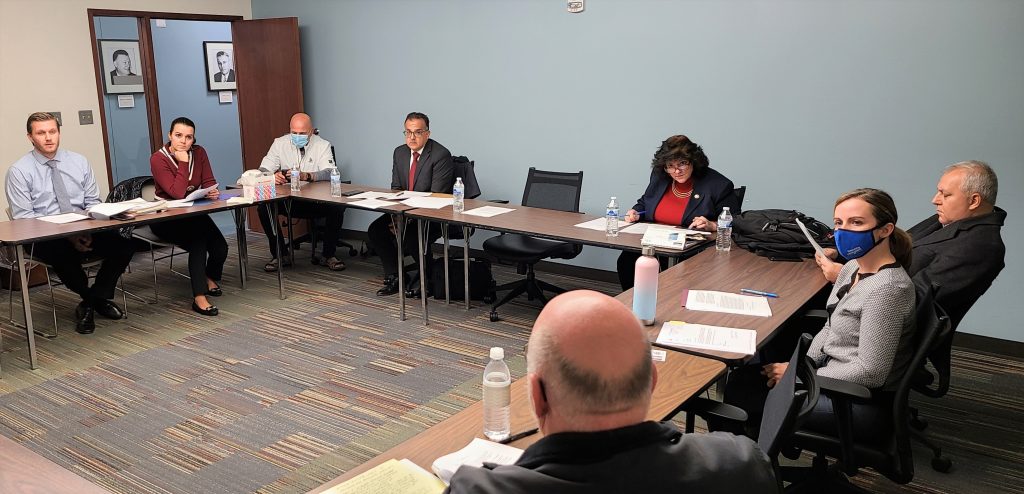
Dearborn City Councilman-elect Ken Paris (fifth from left) speaks at the Nov. 18 study session discussing the body’s rules of order, as assistant city attorney Jeremy Romer (left); Council President Susan Dabaja; and Council members David Bazzy, Michael Sareini, Leslie Herrick, Erin Byrnes and Robert Abraham listen.
Passing the torch
By SUE SUCHYTA
Times-Herald Newspapers
DEARBORN – The City Council met with newly-elected council members during a Nov. 18 study session to discuss the body’s rules of order with respect to resident comment in an anti-climatic session.
With outgoing Council President Susan Dabaja chairing the meeting, and all current council members except Brian O’Donnell present, the goal was to bring the newly-elected, incoming Councilmen Ken Paris, Mustapha Hammoud and Kamal Alsawafy up-to-speed on the changes the current council had considered, to allow the new body to make the decision it chooses when it convenes in January.
The current body did not make changes before the election, then found itself hesitant to presume the incoming council would want to have rules of order imposed upon it by the preceding council.
Councilwoman Erin Byrnes said she removed from the draft language that referred discipline and removal from meetings, and simply retained a paragraph which referred to maintaining an environment which allowed for the orderly conduct of business.
“It reads, ‘Meetings of the city council shall be conducted in an orderly manner, to ensure that the public has a full opportunity to be heard, and that the deliberative process of the city council is retained at all times,’” she said. “‘The city council president or the presiding officer, in their absence, shall be responsible for maintaining the order of meetings.’ I like that paragraph, and it is pretty straight-forward.”
Byrnes said she felt the paragraph reinforced what the council sought, which was to maintain the order of the meetings, so that council members and the public could be heard in an orderly fashion.
Paris suggested that the rules of order should contain language which addressed disorderly behavior.
“The Michigan Municipal League handbook suggests that there be an ordinance governing the disruption of public meetings, and stipulate procedures to be followed, and who is identified as a sergeant-at-arms, which is usually dictated as a sheriff or police officer,” he said. “If you ever get to a position that you have to remove somebody, you really need to define what disorderly conduct is, as much as possible, in generalities that is easy to understand.”
Paris said the city of Dearborn has a disorderly person ordinance which could be included.
He also suggested that the person chairing the meeting use the gavel more frequently.
Dabaja said that while the council wants to encourage resident participation, she uses a lot of restraint using the gavel simply because she doesn’t want attendees to perceive a rigidness to the meetings.
“I think through my approach I try to maintain civility and order,” she said. “I quite often ask members of the public, if they are stepping out of hand, or doing anything that would be seen as disturbing, to refrain from doing that.”
Dabaja said she doesn’t like to call people out or use the gavel “like a dictator.”
“I think that’s style, and that will be up to the next council president,” she said. “I think the way I have handled the meetings the last eight years have been quite pleasant, and I think overall our meetings have run very efficiently and we have gotten our work done.”
Dabaja said she believes that the new council should vote on the rules of order in January, but it is still appropriate to hold the study session with the outgoing council.
“We can work through this and offer guidance based on our own experience, and ultimately, you guys all decide,” she said.
Councilman David Bazzy said a lot of thought went into the draft document because the online meetings were getting out of order, and the council meetings were resembling town hall meetings more than council meetings.
“The job of the city council meeting is to do what the council is required to do,” he said. “It is not a town hall meeting. It is a limited public forum.”
Bazzy said the Committee of the Whole meeting is to set the agenda, and the other meetings are to run the agenda.
“It is important that you have rules of order that exist so that the chair can then conduct the meeting in a fashion that the business of the city gets done,” he said.
Bazzy said when information hits social media, it develops a life of its own.
“I always tell people, things on social media travel like the speed of light, and the truth gets on the turtle’s back and tries to fall backwards,” he said. “I am hoping that we can get something that is a template for moving forward, and we can move it forward so you guys have something to start with.”
Bazzy said the city charter gives the city council all the rules to which it needs to refer.
Councilman Michael Sareini concurred, and said the city charter is very clear about what the new city council should review within 120 days of being seated.
“The charter is telling the council that is incoming that they are going to review those rules and govern themselves for four years,” he said.
Sareini said first readings of resolutions will not be changed later, and when he assumes the city council presidency in January, the council will “do things right the first time.”
Dabaja took issue with Sareini’s statement.
“For clarity, there are many times we have done things right ‘on the first reading,’” she said. “Just to put it out there.”
Byrnes said she believes that the outgoing council has provided a solid blueprint and draft for the incoming city council.
“I will say we have done a tremendous amount of work on this,” she said. “I am very passionate about the public comment portion, so that has been a passion project of mine, and I appreciate all the collaboration from the Legal Department and all the conversations we have had.”
Byrnes said there is a lot of value in the current body passing along what it believes is a solid draft, based on its experience during the past four years, particularly throughout the pandemic and the online meetings.
“We have been thrown into a lot of new situations, in terms of how a public body meets and conducts itself, and how members of the public participate, which is incredibly important,” she said. “We have three new incoming members who are highly capable and intelligent people, and I know that you all will add a lot to this document in terms of additional edits, to make it stronger, to make our meetings even more efficient and more effective than they already are.”
Sareini said his conversations with mayor-elect Abdullah Hammoud’s transition team have indicated that Hammoud will change the process by which council members get information from city officials.
“There will be one point-of-contact, with the chief of staff, and council members will not be communicating directly with the directors,” he said. “The chief of staff would then report back. It is another example of a structural change that is going to be significant.”
Paris said council members should be held to the same standard of behavior as people attending the meetings.
Bazzy said there is a greater expectation with respect to the behavior of council members.
“When you put yourself in a position of leadership, the expectation for you is to show leadership, to show demeanor and show decorum,” he said. “We can disagree, which we should from time to time, but you will never learn anything from the people that agree with you.”