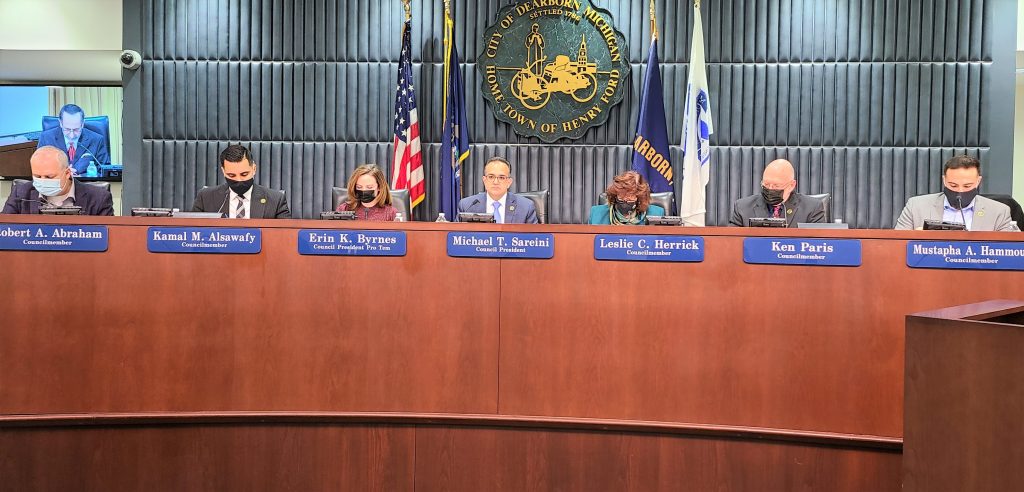
The Dearborn City Council agreed Jan. 25 to remove the sunset provision from the city ordinance which opts out of having recreational marijuana facilities in the city, which protects it from missing a renewal deadline but doesn’t prevent it from amending the opt-out decision in the future.
Wording change protects council from missing renewal deadline
By SUE SUCHYTA
Times-Herald Newspapers
DEARBORN – The City Council eliminated the sunset provision from its recreational marijuana facility opt-out Jan. 25, preventing missed deadlines, while still allowing the body to revise it in the future.
The first reading was held at the Jan. 25 council meeting, with the second reading scheduled for the Feb. 8 meeting.
When the Michigan Regulation and Taxation of Marijuana Act was passed in November 2018, the city opted out, in December 2018, of having recreational marijuana facilities in the city, and added a sunset provision that was renewed on March 9, 2021. It was subject to a second renewal on March 22, 2022.
A sunset clause is a provision within a statute that denotes that the regulation will cease to exist after a given date unless the legislative body renews it.
By eliminating the sunset clause, the body protects itself from missing a renewal deadline and being in the position of not having a proper regulation in place, while still allowing the body to opt in at a future time.
City Councilmember Erin Byrnes said she was not opposed to abolishing the sunset provision, and said that based on some of the community feedback that the council has heard, she understands the opt out, but thinks it is important to continue to study the issue, to look at how cities that opted in and opted out have been impacted, since MRTMA is relatively new.
“I look forward to continuing to study this process and get a sense of what is going on out there, and what the best decision for us as a city will be,” she said. “Certainly, we are always looking for feedback from the public.”
Councilmember Kamal Alsawafy said, as a business development manager, he’s “all about the numbers,” but the tax revenue has been disappointing with respect to recreational marijuana facilities.
He said the city’s only path forward, based on zoning inequities, forces one side of the city to deal with an ordinance to which it is opposed.
“I think it is time to be equitable and fair, and if there is a fair path forward, I want to find it, and I support holding additional study sessions,” Alsawafy said. “We should continue to study our options until we find a fair solution for all residents.”
Councilmember Leslie Herrick emphasized that the sunset provision is only with respect to recreational marijuana sales within the city, and has no impact on an individual’s personal right to have a certain number of plants and use recreational marijuana on their own property.
“We are strictly talking about recreational sales facilities here in Dearborn, and to this date, we have not allowed them to be open here,” she said. “Statistics show, at this point, that recreational marijuana sales facilities in Michigan don’t generate that much money or business for the cities that they are located in.”
Herrick said residents of the city are very divided over whether marijuana sales should be allowed in the city.
“I appreciate that we could opt in at any time in the future if we chose to, if it would look like it would be something our residents want, to have recreational marijuana sales facilities here,” she said. “But at this point, we haven’t heard a lot from our residents saying that they want to have those facilities available for them to purchase recreational marijuana.”
The medical marijuana caregiver act is separate, and, by law, cities are obligated to provide space for caregivers to provide medical marijuana if they are licensed to provide it.
Council President Michael Sareini noted that the City Council chose to not opt-in on medical marijuana businesses within the city, which is separate from caretakers who grow and provide marijuana for medical users.
Mayor Abdullah Hammoud said the city has indicated that it does not want recreational marijuana sales within the city, and he said he has asked the Legal Department to look at the moratorium placed on the medical marijuana ordinance as it pertains to caregivers, to see what can be done with respect to it as well.
He said the city also is in a position in which it would prefer not to offer or expand any licenses on the caregiver warehouse front. He said four or five have been approved, and that there are applicants for more than a dozen. He said he will look into what authority the city has from a legal standpoint.
Hammoud said he would arrange a study session in September for the council with the marijuana regulatory agency to learn of updates and to be aware of the revenue numbers of cities that opted in.
Councilmember Mustapha Hammoud said the numbers on recreational marijuana sales do not always make sense.
“Just the enforcement required to stop crime upticks in our city because of dispensaries,” he said. “They require a law enforcement presence, because they get robbed. They are cash-only businesses. That is just how the laws are right now. It is not a good financial argument for the city to have them here.”
By opting out of recreational marijuana facilities, the city forgoes tax revenue and municipal licensing fees, but does not need to worry about the cost of regulating recreational marijuana within the city, or with the resultant odor.
MRTMA, which legalized the recreational use, cultivation and commercial sale of marijuana in Michigan, defined marijuana establishments as retail growers, safety compliance facilities, processors, microbusinesses, retailers, secure transporters and other related businesses permitted by the state law.