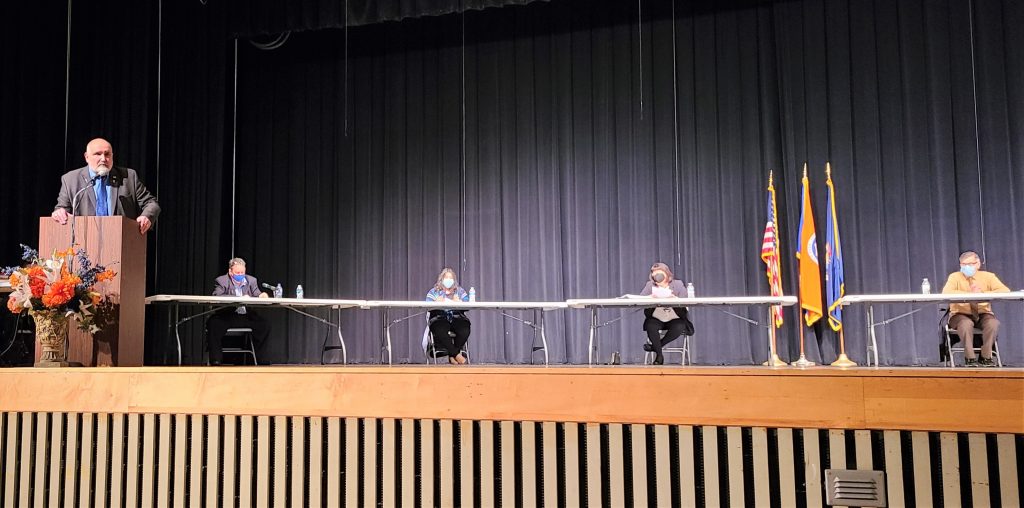
Lincoln Park Mayor Thomas Karnes (left) reads the resolution for the purchase of license plate reader cameras for select intersections, a police department request, at the Jan. 18 city council meeting, held in the Lincoln Park High School auditorium, as Councilmembers Mike Higgins, Lylian Ross, Maureen Tobin and Carlos Salcido listen.
 By SUE SUCHYTA
Sunday Times Newspapers
LINCOLN PARK – The City Council approved Police Chief Raymond Watters’ request to purchase intersection-mounted license plate reader cameras during its Jan. 18 meeting, held in the Lincoln Park High School auditorium.
Watters requested the council waive the bid process and allow the purchase of eight LPR cameras for $20,000 from the sole manufacturer, Flock Safety.
The price includes service fees, data storage, installation and access to other Flock systems for one year, and will be paid from forfeiture funds and a grant the Police Department acquired.
The LPR cameras are stationary mounted, capture license plate numbers and other vehicle features and use electrical power connections or solar power.
The data is shared with other systems throughout the country, and, in addition to license plates, can look for vehicles fitting a specific description.
Watters said other local cities have had great success using the system as a crime deterrent.
“The purchase of the eight cameras will provide our detectives with another tool to combat crime in the city,” he said in a Jan. 7 memo to the council.
The cameras can also look for vehicles by make, color and distinctive features, like a roof rack or unique hubcaps.
The machine readers can interpret paper plates, and identify vehicles without a plate.
The system can set alerts to look for a specific plate or vehicle description. A single camera can capture and process the data from 30,000 vehicles per day, with cloud storage for all of the data.
The LPR cameras are also compatible with the Axon body worn cameras used by law enforcement.
The cameras can also look for and recognize bicycles, all terrain vehicles and motorcycles.
The system has the ability to detect select audio, as well, such as gunshots.
The technology does not use facial recognition software, and does not record where people have been, or use predictive technology to anticipate outcomes.
The data is not used to detect drivers with unpaid fines, and driver data is not sold to third parties.
City Manager James Krizan said the data would not be used for traffic enforcement. He also said the Police Department was not going to announce which intersections would have cameras installed.
Councilmember Lylian Ross said she thinks the LPR cameras are a great idea.
“I want to thank the chief for finding this for us, and finding a way to cover it, also,” she said.