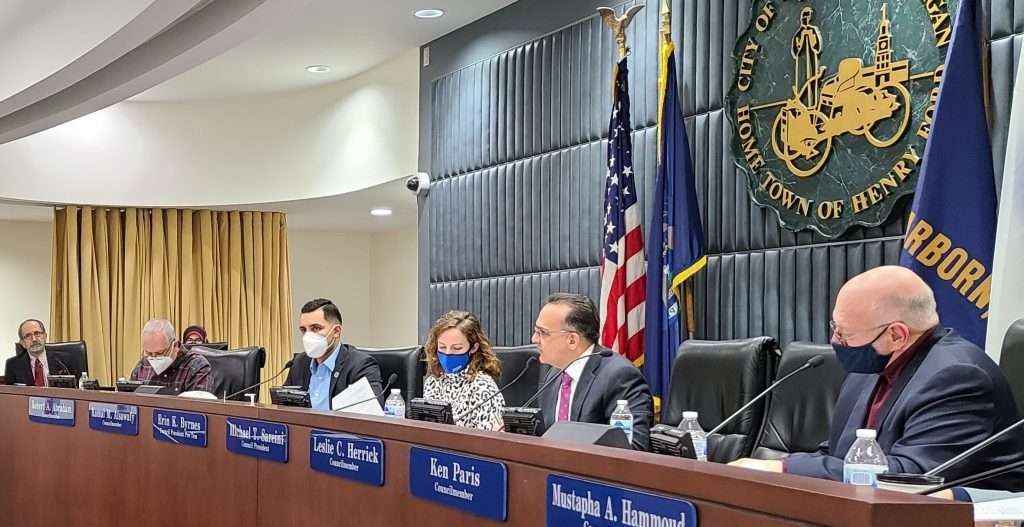
The Dearborn City Council approved the appropriation of $350,000 from sewer fund retained earnings to fund additional system repairs, including addressing sinkholes exacerbated by flooding, at its Feb. 8 meeting.
Sinkholes worsened by flooding to be addressed
By SUE SUCHYTA
Times-Herald Newspapers
DEARBORN – The City Council appropriated $350,000 from sewer fund retained earnings to fund additional sewer system maintenance and repairs, including sinkholes worsened by last summer’s flooding, at its Feb. 8 meeting.
The Department of Public Works staff works year-round to investigate sewer lead blockages and sinkholes, independent of its ongoing sewer infrastructure projects.
Costs are rising in part due to the scarcity of contractors available to perform sewer line work. As the city’s infrastructure ages, more needed work is identified each year.
In Dearborn, most of the public and private sewers are 70 to 100 years old, and are constructed with two-foot-long pipes, with calked joints connecting the pipes every two feet. As the calking dissolves due to age, the joints open, liquid spills out of the pipe and causes soil to erode, which in turn causes sinkholes to occur.
In addition to the city’s year-round sewer inspections, property owners report sinkholes when they see ground depressions and sinkholes occurring in their backyards and on their paved surfaces.
Sinkholes, which represent both health and safety hazards, must be addressed quickly for sewers to be able to carry away waste.
The city has a program that subsidizes 50 percent of the repair cost for all private sewer line repairs. Property owner charges are based on average costs over the past three years, which offers a cushion against recent inflation.
The additional funding the city council appropriated will address the problems in approximately 35 locations, impacting the sewer lines of about 60 to 70 houses.
The work will prevent the formation of future sinkholes and lessen the risk of both sewer backups and raw sewage from entering residential basements.
Mayor Abdullah Hammoud said the city has some numbers for Federal Emergency Management Agency reimbursement for damage caused by last summer’s flooding, as well as expenses incurred due to the pandemic.
Finance Director Michael Kennedy said that they have weekly calls with the FEMA representative, and are 60 to 80 percent done with submitting the costs that the city incurred, and are awaiting approval and reimbursement.
Hammoud said city officials are submitting new damages that surface because of last summer’s flooding, such as sinkholes, as they are notified.
City Council President Michael Sareini said most cities do not help residents pay for the cost of sinkhole repairs that occur on private property.
“This council, and the council before, has instituted always where we had a cap – I believe it is close to $2,000 that we would have the resident pay – and we would pick up the difference, and sometimes that exceeded $5,000 or $7,000 – to dig out your backyard and replace your line, because of the old infrastructure,” he said. “And, of course, with the amount of rain we had during the flooding, we had these things popping up all over, and I am glad that we passed that resolution.”
Sareini said it protects residents by capping what they have to pay for the sewer line repair, and residents don’t have to look for a company to do the work.
“It’s a win-win for our residents,” he said.
City Engineer Yunus Patel said the city is currently aware of approximately 158 sinkholes, and it initially had funding to address 125 of them.
Hammoud said a letter was sent, in multiple languages, to residents who were having sewer system work done on their street, so the contractor could provide them with a discounted option to install a backflow preventer for their residence, which traditionally costs $3,000 to $4,000, but since the contractor is already digging up the road, the residents will be able to opt-in for a $1,500 cost.
Backflow prevention devices are designed to prevent water and sewage from backing up through a basement drain in the event of heavy rain or flash flooding.
He noted that the liability is on the residents to perform the annual maintenance needed for the backflow preventer.
“We are continually working on flood mitigation,” Hammoud said. “So, this is just one additional thing that we will be providing for residents as we move forward, as their streets get dug up.”
Patel said the first backflow preventer recently had been installed as a result of this option.