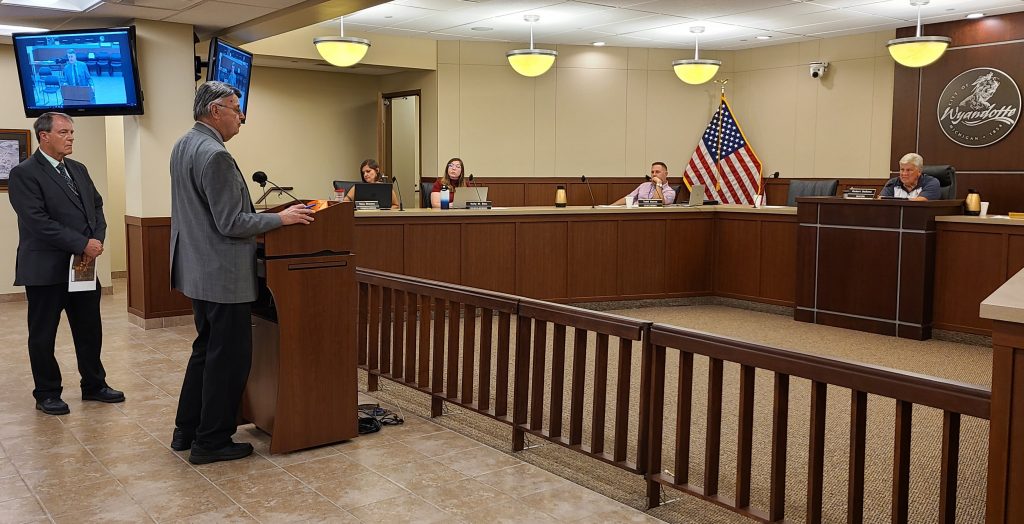
City Engineer Greg Mayhew (left) and City Attorney William Look answer questions about a proposed request for railroad crossing work, as City Council members Rosemary Shuryan, Kelly Stec and Todd Hanna and Mayor Robert DeSana listen.
By SUE SUCHYTA
Sunday Times Newspapers
WYANDOTTE – With Emmons Boulevard closing Aug. 16 to 20 for railroad crossing repairs, the mayor and city council members asked what can be done about the condition of the Eureka’s railroad viaducts.
Mayor Robert DeSana, who said he has heard multiple complaints from residents about the condition about the railroad viaducts, asked City Engineer Greg Mayhew when the city had last approached Conrail about the condition of the viaducts.
Mayhew said the city has last approached the railroad two years ago.
“It’s the same response – they are still structurally sound,” he said.
DeSana asked Mayhew what could be done about the appearance of the viaducts.
“There is nothing in the agreement that requires them to keep the appearance up to our standards,” Mayhew said.
He said they were structurally inspected two years ago.
City Attorney William Look said the city sued Conrail in federal court in 2002, and said the case went down to the Sixth Circuit Court of Appeals in Cincinnati. He said the city originally got a favorable verdict in the district court, but the court of appeals overruled it.
“We handed it back to the federal trial court, and at that point we entered into an agreement with Conrail, where we paid 50 percent, and they were specially assessed for 50 percent, to make improvements to the railroad,” he said. “At that time, it was kind of a gentleman’s agreement that that should last 20 years, although I don’t think there is anything officially in writing.”
Look said the federal court of appeals said that unless the city can prove that the viaduct is unsafe, the city will not go very far in an attempt to pursue the railroad for repairs.
“If we want to go further, we have a three-tiered agreement, and the county is also a part of it, but the county has never stepped forward to assist us in trying to get them to do something,” he said. “So, if you want to get some action, you have to light a fire under the county. I don’t know how you do that, but we are not going to win that battle alone.”
Councilwoman Kaylyn Crayne said she has seen complaints on social media about debris from the viaduct falling on passing vehicles.
Look said people should report those occurrences in writing to city officials, which can be passed on, to document safety issues.
“Any time that happens, we should document that,” he said. “That is what we would need to provide in court.”
Look said that it revealed during the trial that the viaduct was built for trains that were twice as heavy as what are used now.
“That is the argument with the structural engineers,” he said. “If we disagree with them, we have to hire our own structural engineers that are going to contravene that.”
DeSana encouraged council members who hear of damage claims to get people to document the occurrences, and file a police report.
“Maybe we can just send a letter, and ask them if we can put some makeup on the viaducts and dress them up, because there is steel exposed,” he said. “You see it.”
Mayhew said the last time he heard about debris falling, it was some of the parging that was put on the viaduct about 20 years ago.
Parging is a thin coat of mortar that is placed externally on an exterior masonry wall.
Mayhew said the railroad came out and scraped away the rest of the loose flakes at that time.
DeSana noted that scraping off of the parging had a detrimental impact on the appearance of the viaducts.
Councilman Chris Calvin asked if the city incurs any liability if material placed on the viaduct eventually flakes off and falls on vehicles driving beneath the viaduct.
Look said the city would have to have permission from the railroad to do any work on the viaducts, and the railroad would likely have the city sign an indemnification agreement and provide insurance, as well.
Crayne suggested that the city hire someone to evaluate the structural integrity of the railroad viaducts.
“We know it’s crumbling,” she said.
DeSana asked Mayhew to write a letter to the railroad, and asked him to get the structural reports from two years ago, if it is possible to obtain them, and report back to the city council.