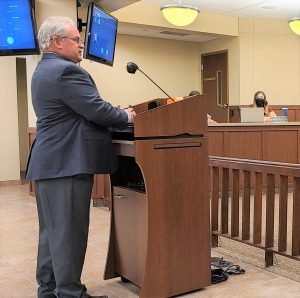
Steve Timcoe (left) of Wyandotte Municipal Services explains the upcoming switch from cable television to streaming media at the Sept. 13 city council meeting.
By SUE SUCHYTA
Sunday Times Newspapers
WYANDOTTE – In response to a senior’s complains about Wyandotte Municipal Services’ upcoming transition from traditional cable television to a streaming service, Supt. Steve Timcoe explained its advantages and economics.
Timcoe said that originally, Wyandotte Cable had planned to offer both cable TV and a streaming service for two to five years, but said as they moved along with the project it became apparent that it was just not technically and fiscally possible to run both the old and the new.
“With the new, we are excited about the fiber optics system that we are building,” he said. “We will have the fastest Internet that basically is available out there to anyone anywhere today.”
Timcoe said Wyandotte Municipal Services will migrate to the traditional cable package of services, but it will be delivered by a fiber optic delivery system.
He said he had written a detailed response in response to the senior’s letter, which was read into the city council record during the Sept. 13 meeting.
Timcoe said WMS takes pride in the services which it provides to residents, which launched in 1983 with 52 channels of analog television, until the mid-1990s, when new technology arrived on the scene.
“We rebuilt the system in 1999, and we added digital, we added HD, we rolled out this funky new thing called the Internet, and in 2007 we rolled out digital phone,” he said. “In 2014, we went all digital, because technically it didn’t make any sense anymore to continue the analog any further.”
Timcoe said that now, many more years since the last system rebuild, this current iteration will be its third generation.
“And, actually, fiber right to the premise in a home, with nothing in between the point of origination and the premise, is considered the Holy Grail of telecommunications architecture at this point,” he said. “We are proud to be able to deliver that, but it does come with some drawbacks.”
Timcoe said this change makes more of a technological leap than in the past, and instead of moving along slowly while embracing the new technology, they are going to jump ahead of the pack, and said it became apparent that, as they strategized and went through a fiscally responsible build, this decision got them ahead of the curve, and they determined that they were not going to be able to continue with both systems.
“So, I kind of look back – and I am getting up there in age myself – and I am a traditionalist, and like my cable box, and I like the traditional delivery method,” he said. “But I would be remiss and derelict in my duties if I just took into account what I believe now is the minority, and not the majority.”
Timcoe said that while WMS tries to please all of its customers all of the time, most people know that is not always possible, so they weigh the best interest of the majority, and bring all of its customers along with that decision.
“Typically, when we do that, the people that aren’t part of the majority initially that are looking forward to it look back and say, ‘You know, that was a pretty good thing,’” he said. “When we went digital in 2014, most of the people that were kind of adverse, who said, ‘Why don’t you leave what I have, I like it, it doesn’t need to change,’ they liked it even more.”
Timcoe said there are still people who are watching standard definition signals through Wyandotte Cable, and that is not the way most people are watching their services anymore, since high definition provides a much higher quality picture.
“So, I am hoping that once people become adapted, and find out that it is not all that difficult, even though it is different, that when they see the HD versions of the signals they have been watching in SD, they will come up to me at some point, begrudgingly, and say, ‘Thank you, I am really glad that we did that,’” he said.
Timcoe compared the transition from rotary dial phones with party line connections, to touch-tone phones, cordless phones, and wireless smartphones, and from phonograph 78s to vinyl 33s and 45s, to 8-track tapes, cassette tapes, CDs, MP3s and electronic storage and bluetooth.
“So goes cable, from a few dozen analog channels on an all-coaxial cable to digital standard definition, to high definition, to Ultra 4K, to streaming video, to Internet, to digital phone, on HFC or hybrid fiber coax plan, and to all those things and more, on a state-of-the-art, fiber optic plan,” he said.
“This is the natural state of progression, and technology has been on such a torrid pace, that the time frames that used to be 10 and 20 and 50 years are now 5 and 10 years, or two years, or even one year or less.”
Timcoe said they have done their research and are proud to be called “the hometown provider.”
He said they have developed a marketing campaign to identify concerns and answer questions.
“All of that will be coming soon, as we look forward to starting the transition in the beginning of 2022,” he said, noting that their Gannt chart to-do list was about three feet long.
He said the entire transition will probably take eight to 18 months to accomplish.
“Being mindful that typically a lot of the seniors may be entrenched into the traditional cable, and be more resistant to the change, we’ll probably pick some of the areas, like the high-rises over on Biddle and make those the last ones that we transition, so that they can have the traditional service the longest,” he said. “But, when we’re all said and done, we are still going to have that same traditional cable bundle.”
Timcoe said some streaming services don’t have local sports and live, local news, but WMS will still supply that. He also said that being an Internet connectivity provider, as opposed to just a cable TV provider, has allowed them to stay in business.
For more information about the transition, go to wyandottecable.com.