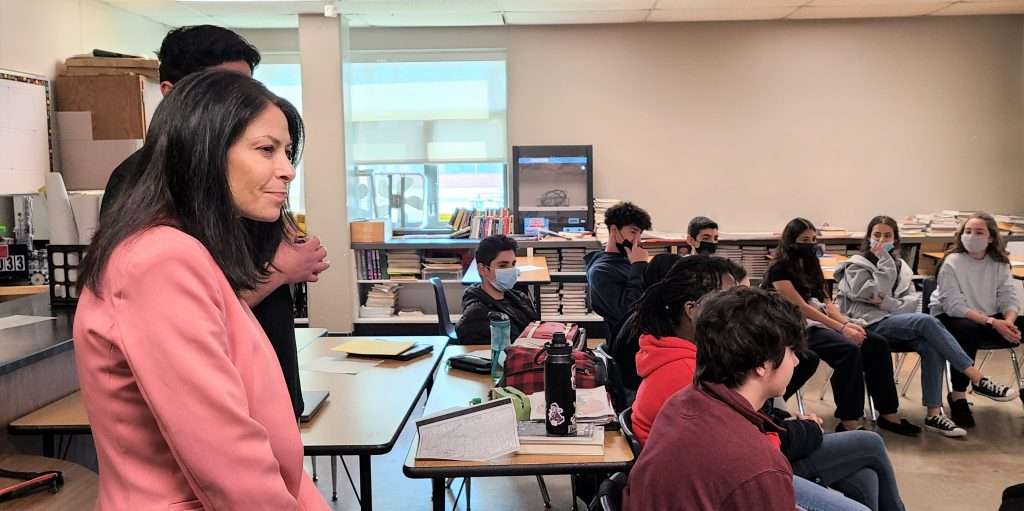
Michigan Attorney General Dana Nessel (left), with Rashid Baydoun (second from left), Restorative Practices facilitator, learns how circles are used with students at Riverside Middle School as part of its restorative practices initiative to build community, restore relationships and repair harm in an increasing disconnected world, in response to state-based legislation to improve student behavior and discipline.
By SUE SUCHYTA
Times-Herald Newspapers
HEIGHTS – Building kinder, safer schools with increased learning time is the goal of Restorative Practices, which Michigan Attorney General Dana Nessel saw successfully practiced April 5 at Riverside Middle School.
Restorative Practices have been implemented at Riverside, and will soon be rolled out throughout the Crestwood School District, in response to the Michigan Legislature’s requirement that schools develop evidence-based plans to improve behavior and discipline.
Restorative Practices, which are based on the principles of restorative justice, seek to build community, restore relationships and repair harm in a world that has become increasingly disconnected.
The basic philosophy is that if people are happier, they are more cooperative and productive, and more importantly, willing to change their behavior in positive ways, especially when those in authority do things with them, which is restorative, instead if doing something punitive or doing something for them.
In schools, restorative practices reduce misbehavior, violence and bullying, which improves the learning environment and enhances school safety, while also improving relationships and attitudes.
The mechanics of instituting Restorative Practices include learning circles, during which listening, mutual respect, understanding and empathy are important components.
Crestwood Supt. Youssef Mosallam said that using Restorative Practices creates a mindset change.
“It is changing the paradigm of what student ‘discipline’ is,” he said. “Too often, in education, or in the world, we look at people for the act they commit, instead of identifying what led them to that, as well as identifying and teaching people how others feel what it placed on them.”
Mosallam said that, even before the pandemic, one of the district’s goals was to enhance social and emotional learning.
“Our philosophy is you cannot reach students on the literacy and the numeracy, on the instructional needs if you can’t get past the firewalls of their social needs,” he said. “If a child’s first concern is their safety, it doesn’t matter what the teacher is saying in the front of the classroom.”
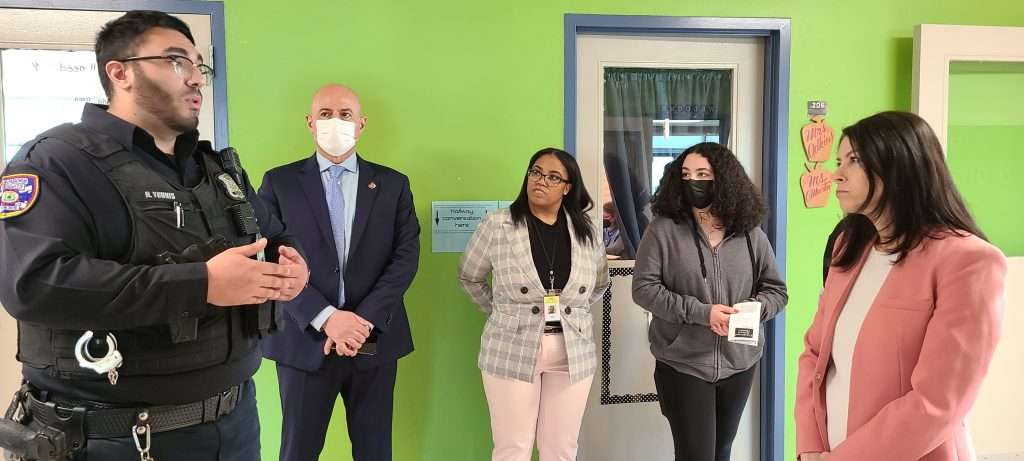
School Resource Officer Hamze Younis (left) explains how restorative practices at Riverside Middle School impact his role, as Dearborn Heights Mayor Bill Bazzi, Restorative Practices facilitator Tashara Ewing, eighth grade student Karima Elsersy and Michigan Attorney General Dana Nessel listen.
Mosallam said when children came back to school after almost two years of unstructured, at-home learning, it was tough on everyone, and today’s sixth-graders were fourth-graders when they were last in a school classroom.
“That is two years of growth which that child has lost in a social environment,” he said.
Mosallam said the process hasn’t been easy, but their imperfections are helping them become better for the future.
“It’s a change of mindset, and we are really excited with the direction we are going, and we are so excited that you are here to see our work in progress,” he said.
Mosallam said Restorative Processes could be expanded across the state, to stop the school-to-prison pipeline and to help children understand the impact that their actions have on others, and on themselves, while finding the support systems which will help them to be successful.
Restorative Practices facilitator Rashid Baydoun, who is trained in the processes as well as certified to train others to teach it, said he was glad to return to the school district that he attended as a student and to take the whole child approach.
“If a student doesn’t feel safe, if their basic needs are not being met, their educational needs will not be met,” he said.
Baydoun said a community must be built, because you can’t fix something that wasn’t there in the first place.
“It’s a paradigm shift in how we think about student discipline,” he said. “Discipline isn’t just for the rule that is broken, it’s understanding the impact.”
Baydoun said it is doing away with the zero tolerance policies of the late ’90s and the early 21st century.
He said headway can only be made by having authentic dialog, and there is no quick fix.
Baydoun said that assigning consequences does not teach students to learn from the situation and respond differently in the future.
“Relationships are the heart of our work,” he said. “It is all about relationships.”
Baydoun said affective statements are used to tell a student how their actions affect someone else, and how it makes the other person feel.
“It really delivers the importance of changing those behaviors,” he said.
Baydoun said counselors and social workers play an important role in the process, helping students to understand that it is “the deed, not the doer.”
School Resource Officer Hazme Younis said part of his role is to build relationships with the students and staff, and being a mentor in learning circles with students is an excellent way to restore harmed relationships.
He said the Restorative Practices training he has taken has provided valuable on-the-job skills.
“I know this is something that can work and can repair relationships,” Younis said. “We want to restore it, instead of just brushing it to the side, and walking away from it and just leaving a temporary resolution.”
Crestwood School Board Vice President Sue Kaminsky said Restorative Practices is a community effort.
“It is from the top down, with the city, with the school district,” she said. “Officer Younis knows most of the kids by name, and Dr. Mosallam is a presence in their life, and he knows most of the kids by name, so it is really from the top down, and it is everyone joining together.”
Riverside Principal Scott Casebolt said the benefits of Restorative Practices extend to teachers as well as students.
“There are so many things academically that we have to throw at them,” he said. “I really think it will help future (staff) retention as well.”
Nessel said it is important for educators to feel like they are making a difference.
“It probably also helps in terms of better communication with the students and it makes it easier for you guys to do a very difficult job,” she said. “And then we need to get back to a place where you guys are properly compensated for your work – that is something we need to do better.”
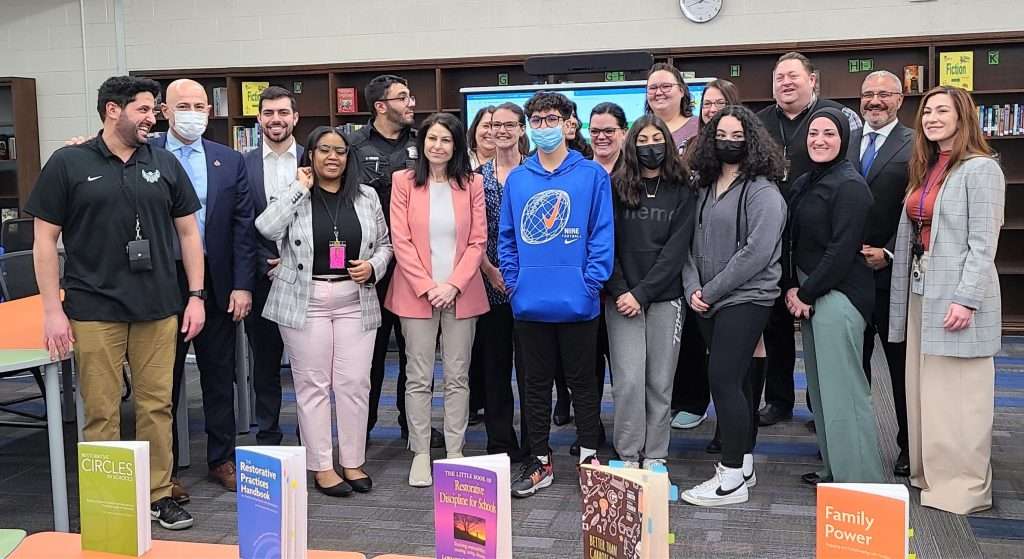
Michigan Attorney General Dana Nessel (sixth from left) poses with students and staff at Riverside Middle School after learning about their successful implementation of Restorative Practices.