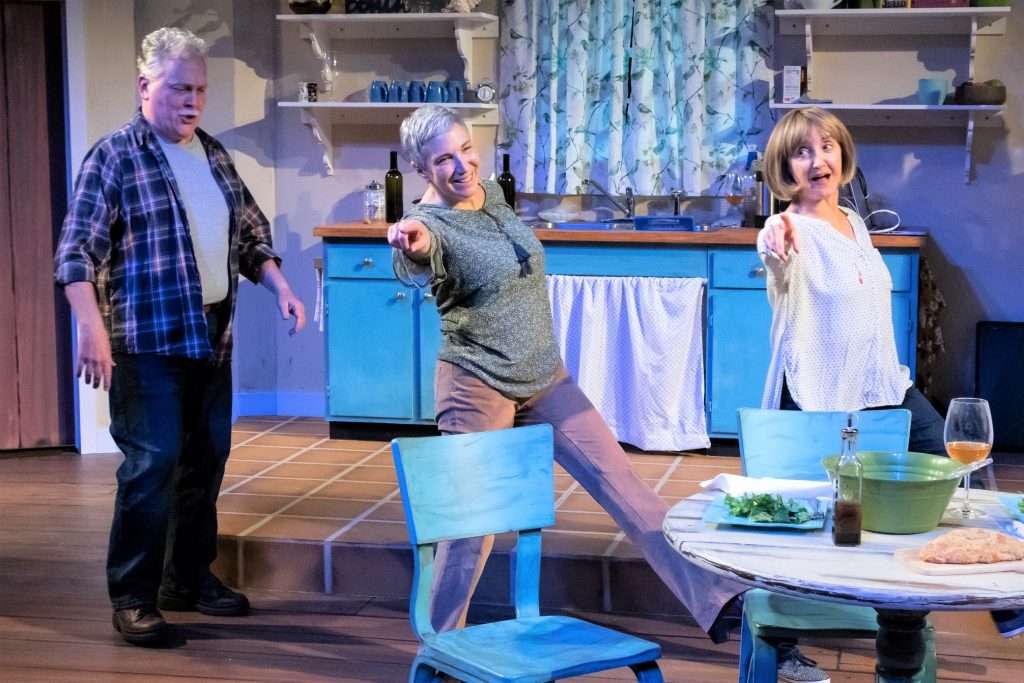
Trenton’s Open Book Theatre Company presents “The Children” through Dec. 11 at the theater, 1621 West Road in Trenton. For more information, go to openbooktc.com.
 Two strong local theater companies – Open Book in Trenton and the Detroit Public Theatre in Midtown – are offering compelling shows that should not be overlooked, even with “Hamilton” packing houses at the Fisher Theater.
OPTC presents Lucy Kirkwood’s “The Children,” about retired nuclear engineers coming to terms with a damaged nuclear power plant and its fallout, while DPT presents the Michigan premiere of Heather Raffo’s “Noura,” about a family that fled Iraq, at the Detroit Public Theatre’s Midtown playhouse.
OPEN BOOK THEATRE COMPANY PRESENTS ‘THE CHILDREN’
Trenton’s Open Book Theatre Company presents Lucy Kirkwood’s “The Children” through Dec. 11 at the playhouse, 1621 West Road in Trenton.
Directed by Sarah Hawkins Rusk of Livonia, the show features Wendy Katz Hiller of Ann Arbor as Hazel, Tina Paraventi of Ypsilanti as Rose and Lindel Salow of Dearborn as Robin.
Robin and Hazel have left their house for a nearby borrowed cottage after an earthquake critically damages a nearby nuclear power plant where they used to work. They seem stuck in an emotionally numb rut until friend and former coworker Rose shows up with a proposal that stuns them and elicits strong and opposite reactions from both.
Rusk said the show is about three flawed people trying to figure out how to proceed in a world complicated by matters outside of their control.
“This play says a lot about the tangled and complicated relationships we have with each other, the obligations we face as we grow older and wiser and the eternal struggle with an inevitable death,” she said.
Rusk said that despite it sounding like a dark tale, “The Children” is actually a beautiful story of three people struggling with the consequences of their actions.
“The play is a feast of moral ambiguity, is beautifully written and keeps you guessing as it reveals the bits of information you need to put the pieces together,” she said. “The actors are brilliant in their portrayal of these complicated, raw humans attempting to reckon with their heads and their hearts.”
Salow said the show reminds one that the choices people make can and do have profound consequences, and impact the lives of those who come after, the children of the title.
He said the set is designed to bring you into the claustrophobic cottage with the characters, which also has limited use of electricity until later in the play, providing necessities but not luxuries.
“We are seeing the dramatic effects of climate change all around us, yet we chose to ignore much of it since it means having to make changes in the lives we live,” he said. “The changes we make now may not have any impact for us but could for our children and grandchildren.”
Paraventi said that obligation is an important theme that touches on many aspects of the story, including the obligation to future generations.
She said the characters are complex and have an entangled history, which gives them a rich background from which to develop their characters, who are flawed but engaging.
“The beautifully written script is populated with characters thrust into a difficult situation,” she said. “Despite the frequent conflict between them, I think the audience will ultimately root for each character,” Paraventi said.
She said the question of the risks and consequences of our energy sources is also a timely topic.
“The conflicts over what we should and should not feel responsible for, particularly in this age of climate change and its increasing global effects, are relevant and challenging,” Paraventi said.
Hiller said “The Children” raises important questions about mankind’s impact on the natural world, challenging us to examine our obligation to the planet and weigh that against our wants and needs.
“What are the ramifications of our choices and what are we leaving for future generations?” she asked. “I’m sure the audience will have a lot to think about and discuss on the way home.”
Hiller said her character’s fears are similar to what many people felt at the beginning of the pandemic when they tried to control what they could to assuage their anxiety.
“Hazel’s need to control things comes from her fears,” she said. “As the world becomes more chaotic, she tries to control her small corner of it.”
The show runs 8 p.m. Nov. 18, 19, 25 and 26 and 2 p.m. Nov. 20 and 27 and Dec. 4 and 11 at the theater.
Audiences must wear face masks as a COVID-19 safety precaution.
Tickets are $30 general admission, with a $25 rate for seniors and $15 tickets for students. To purchase, call 734-288-7753 or go to openbooktc.com.
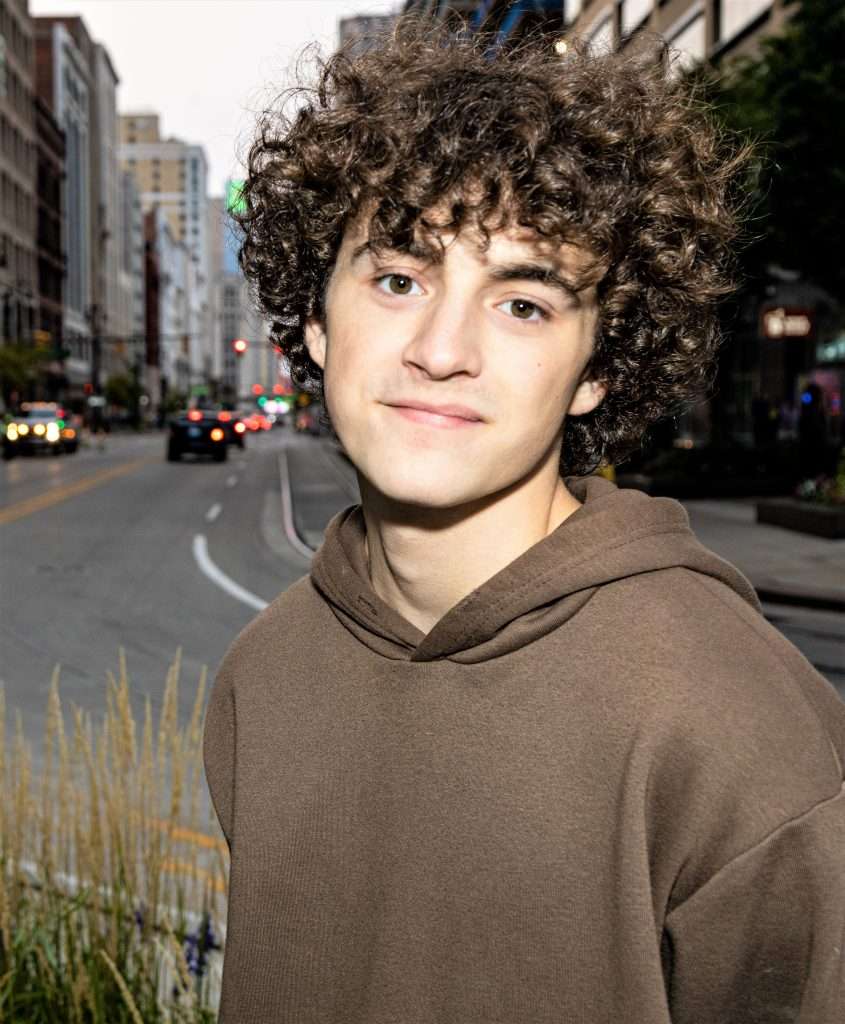
Moogie Fawaz of Dearborn performs in the Detroit Public Theatre’s production of “Noura” through Dec. 18 at the theater, 3960 Third Ave. in Detroit. For more information, go to detroitpublictheatre.org.
DETROIT PUBLIC THEATRE PRESENTS ‘NOURA’
Detroit Public Theatre hosts the Michigan premiere of “Noura,” written by Michigan born Iraqi-American playwright Heather Raffo, who plays the title role of Noura in the Detroit production.
The play showcases the talents of two Dearborn men, with Mike Mosallam directing and Moogie Fawaz, a senior at Edsel Ford High School, making his professional acting debut.
The cast also includes Egyptian movie star Kal Naga (also known as Khaled Abdol Naga), Mattico David and Amanda Najor.
DPT founder and artistic director Courtney Burkett said she is thrilled to bring Raffo and her play home to Michigan, and hopes the show, which tells the story of an immigrant Iraqi-American family, will introduce new people to the DPT.
“Metro Detroit is home to the largest Arab American community in the country, and our job as artists is to produce work that our community can see their own experiences reflected in,” she said. “It would be short-sighted of us to not be in communication and conversation with the Arab American community in this region through our work.”
Burkett said the cast is remarkable.
“Dearborn native and director Mike Mosallam has assembled a truly world-class cast for this production,” she said. “The New York Times called Heather Raffo’s performance of this role ‘radiant,’ and Kal Naga is an Egyptian movie star who is often referred to as the ‘Brad Pitt of Egypt.’”
Burkett said Mattico David is also an established actor who has worked with prominent acting companies across the country.
“It was very important that the entire cast be Arab American,” she said. “We are happy that we were able to accomplish that goal and have actors of this caliber on our stage.”
Fawaz said local high school theater director Greg Viscomi recommended he audition for the role when the creative team was seeking an Arabic teen actor.
Fawaz said many Arab Americans come from war-torn countries, which people hear about on the news but may not understand the impact on individual families.
“Many of our neighbors have gone through stuff we’ll never experience but should try to understand,” he said. “It’s a unique show and the content is nuanced and complex.”
Fawaz said his friends and family have never seen him in a role like this before, and he is learning technical skills like articulation, slowing his speech and projection.
“Mike (Mosallam) likes to ‘bring life to the play’ through little, everyday actions, and he’s looking for authenticity,” he said. “The direction is making me a better actor.”
Fawaz said he hopes to continue to act locally and to major in theater when he starts college next fall.
“Stage (acting) seems fulfilling because you are live and it is very physical,” he said. “Film is appealing because it reaches a broader audience and offers the chance to travel to new locales.”
The show runs 8 p.m. Nov. 16 to 19, 25 and 26; and Dec. 1 to 3, 8 to 10 and 15 to 17; and 2 p.m. Nov. 20, 26, 27, and Dec. 3, 4, 7, 11, 17 and 18 at the theater, 3960 Third Ave. in Detroit.
Friday and Saturday tickets are $52.40 general admission, or $40 for those 30 and younger or 65 and older. Wednesday, Thursday and Sunday tickets are $45 general admission, or $35 for those 30 and younger, or 65 and older.
To order, call 313-974-7918 or go to detroitpublictheatre.org.