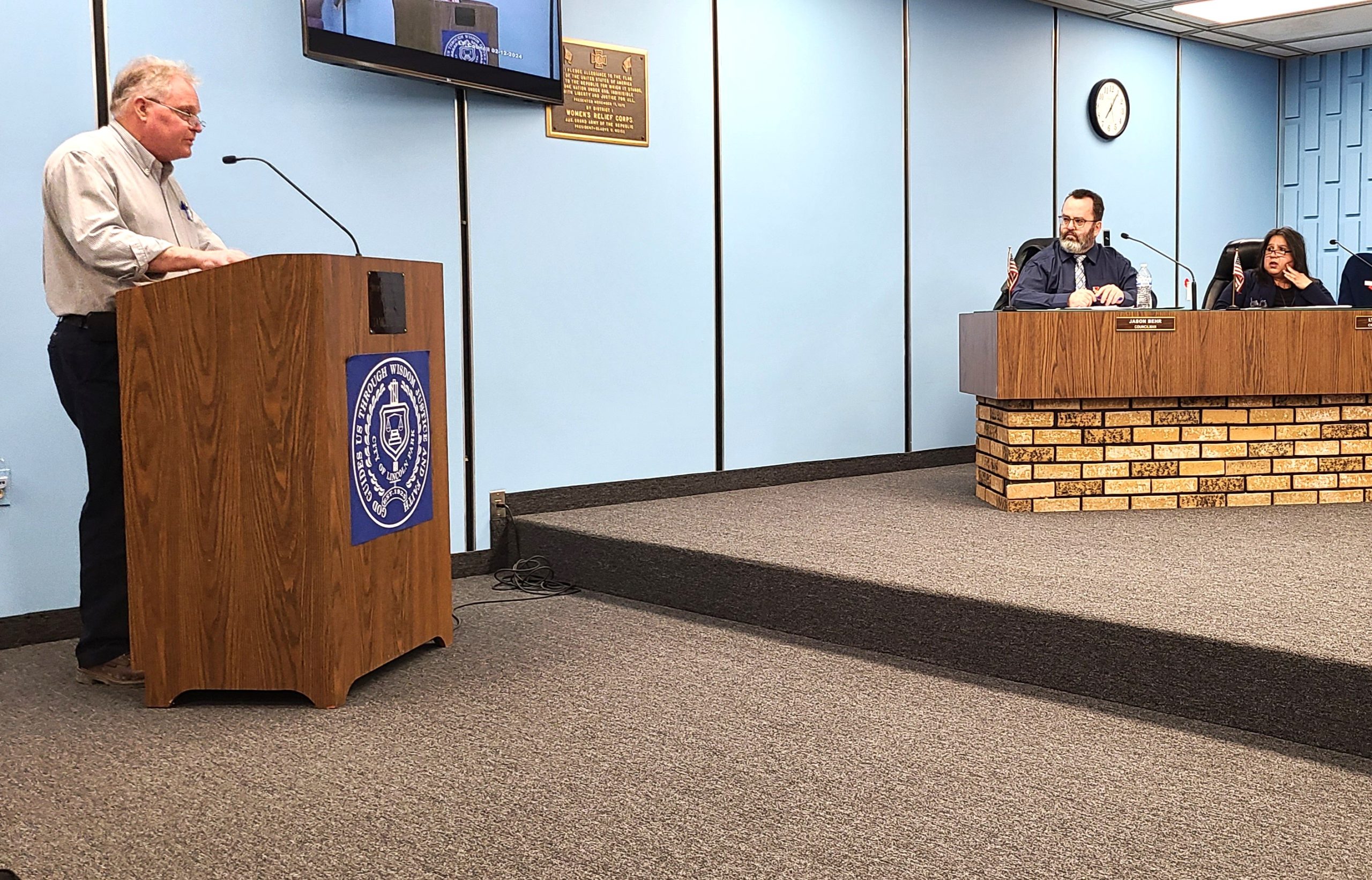
Lincoln Park Department of Public Services Director John Kozuh (left) speaks about the events that led to basements flooding with sewage during the Feb. 12 City Council meeting as Councilmembers Jason Behr and Lylian Ross listen.
Pump station employees didn’t know about 1940s-era reset button
By SUE SUCHYTA
Sunday Times Newspapers
LINCOLN PARK – Pump failures at the Emmons Street Pump Station and the retention basin during an excessive rain event and snow melt led to sewage backup flooding in about 174 residential basements.
Department of Public Services Director John Kozuh spoke at the Feb. 12 City Council meeting to explain the weather events and system failures that led to basement flooding, manhole covers to be blown open, and sewage to be released into the Ecorse Creek.
At the pump station at 3:59 a.m. Jan. 26, a high-water alert indicated 24-feet of fluid in the wet well at the station. When DPS crews arrived, the station had electrical power but none of the three pumps were operating, yet none of the breakers had been tripped.
At 5:47 a.m., DTE was contacted to see if there was a problem with the pump station’s electrical feed. DTE switched the pumps to an alternative electrical feed, but the pumps could still not be started up.
At 6:30 a.m. an electrician found and engaged an unlabeled 1940s-era reset button, which allowed all three pumps in the pump station to once again become operational.
Kozuh said that the pumps have never had to be reset in this manner before, and the knowledge of the control panel had always been passed on person-to-person. Kozuh said that to his knowledge, DPS has never had to use the unlabeled reset button in the past.
He said they are trying to learn if a situation with DTE caused the pumps to need to be reset without the breakers tripping.
Kozuh said that at the same time, at the retention basin, pump 3, which had been sent out for repairs recently, was not operating correctly, and four pumps (pumps 1, 2, 4 and 5) were operating instead of the normal five to dewater the sewage and the retention basin wet well.
Eventually, pump 6, a backup pump, was placed into sequence with pumps 1, 2, 4 and 5 to replace pump 3, which could not be made operational. It is suspected that a miswiring might have occurred when pump 3 was sent out for repair.
When the Emmons Street Pump Station and the Retention Basin were unable to remove excess flow from the city’s sanitary system, which was exacerbated by the heavy rain and snow melt, it is believed that when the pump station pumps came back online, a back water condition occurred that caused a hammer effect that dislodged sewer manhole covers at street level, literally blowing them open and allowing raw sewage to flow onto nearby streets.
At 5:45 a.m. Jan. 26, with the retention basin at its 20.5-million-gallon capacity, the excess capacity of raw sewage was released into the Ecorse Creek.
Before the basement sewage flooding, the city had already gone out for bid to replace the outdated technology in the city’s pump stations and at the retention basin.
City Attorney Ed Zelenak acknowledged that some council members were affected by the basement flooding.
“You know how invasive and intrusive it is,” he said. “The city has never made excuses.”
He said the city has brought in an engineering firm and DTE to assess the situation, and the city will accept responsibility for any situations for which it is responsible.
Zelenak said a definitive answer cannot yet be supplied, because the situation is impacted by multiple variables.
“The public has a right to know, because ultimately these settlements get put on the backs of everyone here in the community, so if you see culpable parties, the city will go after the culpable parties,” he said. “We’ve been through this at least three times in the last half decade, and the city will go after whoever is responsible.”
Mayor Michael Higgins said he is sorry the basement sewage flooding happened to residents. He reiterated that two council members were affected, as were two past mayors and several commissioners.
“This is not something that happened to just you, but we are very sorry that it did happen,” Higgins said to residents attending the city council meeting. “We are not saying it was our fault, but we are very sorry that it did happen.”
Several residents spoke of the impact of several feet of raw sewage backing up into their basements.
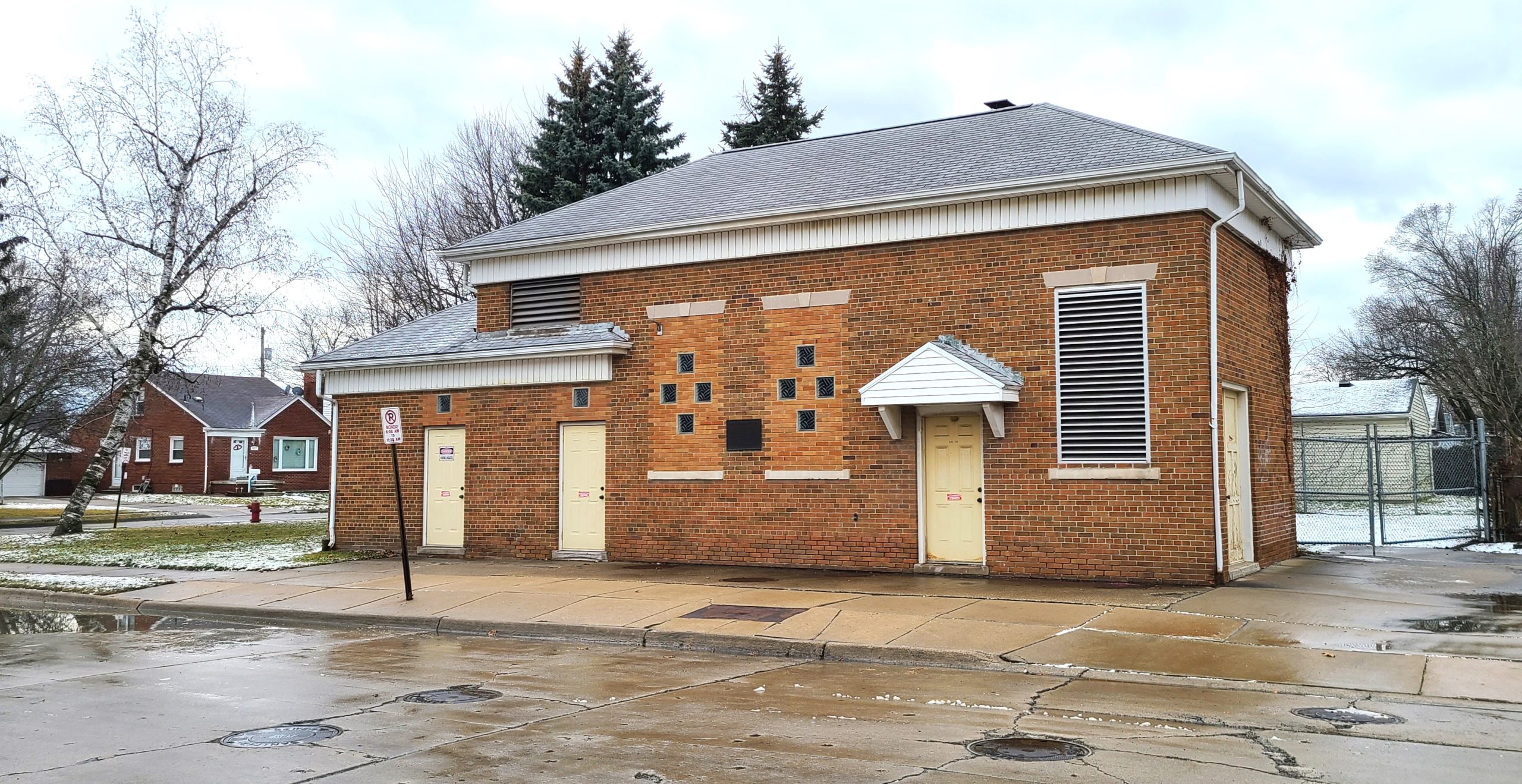
Three pumps at Lincoln Park’s Emmons Street Pump Station failed in the early hours of Jan. 26, which was rectified at 6:30 a.m. when an electrician discovered an unlabeled 1940s-era reset button which enabled the three pumps to resume operation.
Resident Anayancy Chapa Kowalsky said the recent event was the 12th time her basement has flooded during the 11 years she has owned the house, with seven of the incidents causing significant damage to her basement, and causing structure issues and loss of belongings.
She said the value of the items lost has exceeded $60,000, which included replacing the furnace and water heater twice, and going through five sets of washers and dryers.
“As a lifelong resident of Lincoln Park and a member of our school board, I hold a deep love for our city and home,” Kowalsky said. “However, with the latest flood my husband and I contemplated putting our home up for sale.”
She said it is disheartening that no one seems to be held accountable for the ongoing damage they have experienced.
“My concern extends beyond the immediate financial impact,” Kowalsky said. “I fear potential hidden damage that may affect the retail value of our home when it undergoes inspection.”
She said she understands the complexity of the issues, but said if prompt and effective measures are not taken, she will have no choice but to pursue legal action.
“I urge you to address this matter urgently to prevent further damage and distress to the residents who love and cherish our city,” Kowalsky said.
Resident Debbie White, who moved to Lincoln Park in 2016, said her basement has flooded multiple times, and she has lost a washer and dryer, refrigerator, freezer and stove.
“I would like to put my house up for sale, and I would like the city to buy it at market value, because I am not going to get my value out of my house,” she said. “Who wants to move into a city with a history of flooding?”
White asked if the city could install backflow preventers in residential basements.
She said she wants to move out of Lincoln Park because she feels the city is not fixing its infrastructure.
Resident Chris Holland, who has lived in Lincoln Park for 10 years, spoke of telling his 8-year-old daughter and 10-year-old son that their belongings in the basement were destroyed by sewage water flooding.
“It was one of the harder things I have had to do as a dad,” he said. “I’ll never forget the tears and the sobbing of my daughter that entire day, and I had to pick her up from school because of how inconsolable she was.”
Holland said he reminded her that they are just things, but he acknowledged that possessions have value and are connected to memories.
He said their basement was professionally remodeled with drywall, carpeting, cabinets and an entertainment center. He said he’s had to drag possessions to the curb multiple times since he’s lived in the city.
Holland said he wishes the city had warned them in time to allow them to start removing items from their basement.
“The lack of communication is unacceptable, especially when a (pump) failure is known,” he said. “The first conversation I had with my wife that morning is, ‘Is this it? Do we move?’ Do we sell our house and try to piece things together as best we can here and sell it at a loss or sell it for less than it is worth, just to not have to deal with this again?”
Holland said he is fortunate to work in the restoration industry, and he had a team from his company come out and do a lot of the mitigation and cleanup. He said services like that cost thousands of dollars, and sewage cleanup should be handled by professionals because of the health risks it presents.
Holland said that most residents are not covered by insurance for that type of restoration.
Resident Carolyn Adkins lives close enough to the Emmons Street Pump Station to be able to hear when the pumps are or are not running. She feels the city workers should have told nearby residents that the pumps were not working.
“The accountability is on the city,” she said. “And, I’m sorry, there was a reset button? A reset button that you could have pushed to stop all of this, but it’s not your fault?”