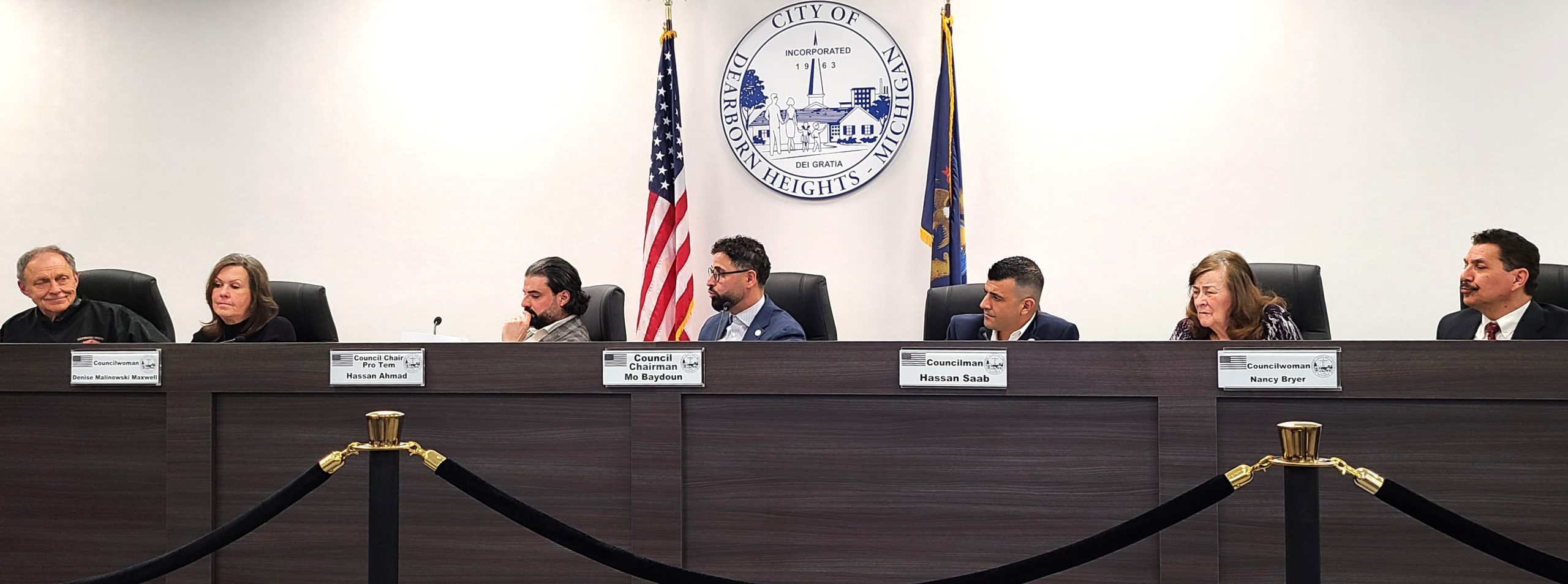
The Dearborn Heights City Council denies Interim Police Chief Kevin Swope and Support Services Director Paul Vanderplow’s request for patrol fleet digital license plates to monitor vehicle activity, and for a CellHawk analytical toolset, which uses cell phone call data records and geolocated data to determine suspect and victim location and history and other data patterns, during the March 12 council meeting.
By SUE SUCHYTA
Times-Herald Newspapers
HEIGHTS – The City Council denied Interim Police Chief Kevin Swope’s requests for patrol fleet monitoring digital license plates and for a cell photo data analytical toolset at its March 12 meeting.
City Council agenda item 7-C, a request for the acquisition of equipment and services to support patrol fleet digital license plates for the department’s 32 vehicles, would monitor vehicle activity while purporting to enhance officer safety and support risk mitigation efforts.
The tracking could provide officer accountability and fleet asset management information.
The council unanimously denied the motion.
Councilmember Hassan Saab said the digital license plates were “useless,” and said he knew of no other police departments that were using them.
Councilmember Hassan Ahmad said the request was an “extra toy” that was not needed.
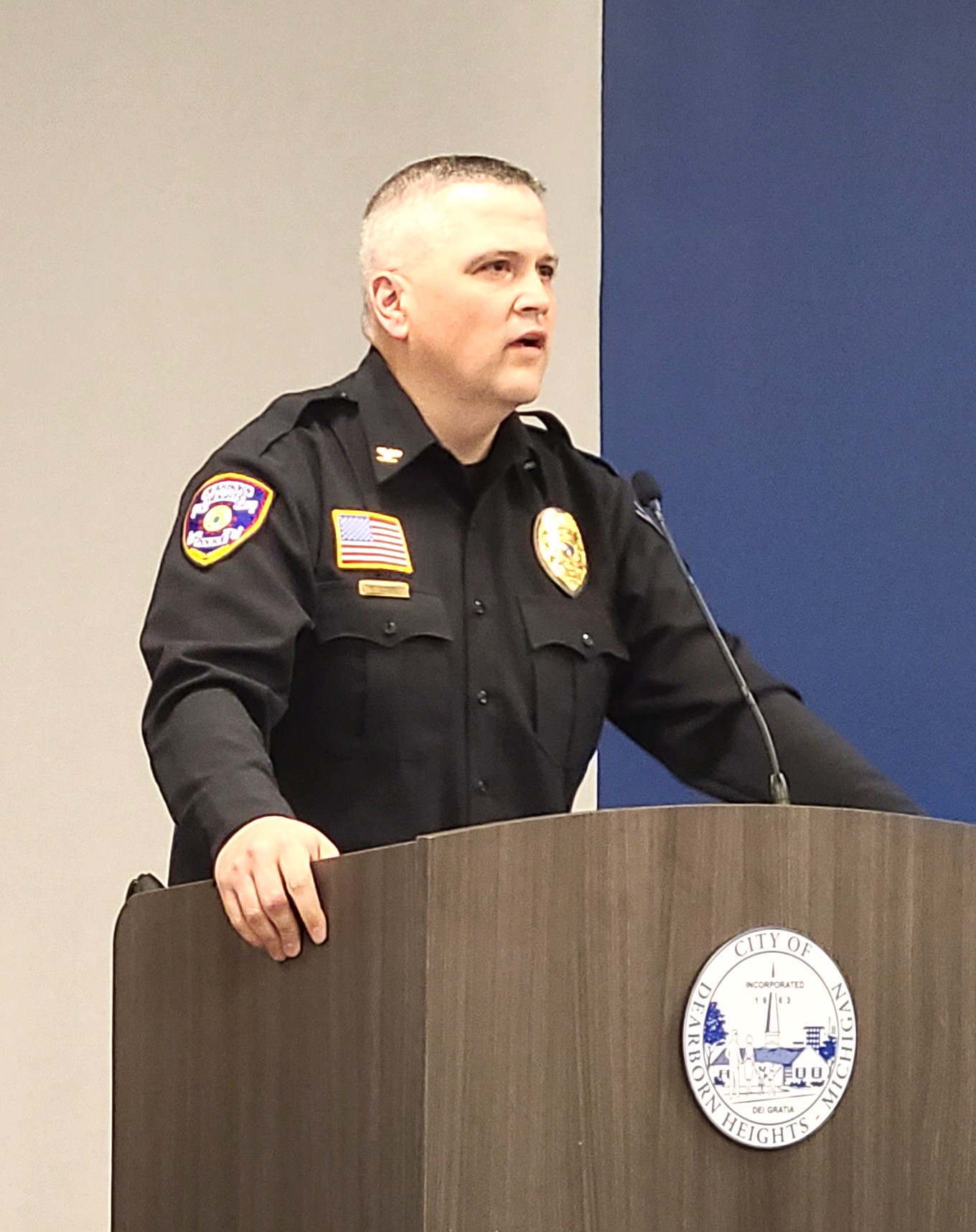
Interim Police Chief Kevin Swope explains a police request for patrol fleet digital license plates to monitor vehicle activity, and for a CellHawk analytical toolset, which uses cell phone call data records and geolocated data to determine suspect and victim location and history and other data patterns, during the March 12 city council meeting, which the council did not approve.
City council agenda item 9-C, a request for a CellHawk analytic toolset, was denied by a 5-2 vote, with Councilmembers Robert Constan and Nancy Bryer in favor, and Councilmembers Tom Wencel, Densie Malinowski Maxwell, Hassan Ahmad, Mo Baydoun and Hassan Saab opposed.
The data analysis tool uses cell phone call data records and geolocated data to investigate and suppress crime.
Swope said the data analysis uses the “Internet of Things,” devices emitting transmission signals, to visualize evidence in seven analysis modes.
It overlays cell tower locations with maps to highlight connections between locations and people.
It can also plot device pings in response to a legal process or exigency, in which priority of life allows for data access in advance of a legal request.
Mobile device location data can help locate missing persons, recover fugitives, prioritize or deprioritize suspects, identify a victim and suspect’s proximity to each other, to estimate speed or route of travel, and to identify time windows associated with crime events.
It can also corroborate evidence with data streams from closed circuit television, automated license plate readers, ankle bracelets and social media.
Cell tower dumps can find phone numbers connected to a target location, with GeoFences able to identify all devices active in an area during a time frame and to create a closed shape of its map.
Saab expressed concern that the training needed to effectively use the system is extensive and expensive, and he expressed concern that the system could be abused.
Swope said CellHawk is a great tool for law enforcement.
“Our detective bureau would use this tool to solve crimes such as kidnappings, human trafficking, fatal hit-and-runs, homicides,” he said. “Things where the suspect takes off. We had an armed robbery the other night, in the middle of the night, and if someone commits an armed robbery at a gas station, we would be able to triangulate possibly who was there.”
Swope said police detectives and crime analysts would use the tools to solve the crimes that the community expects them to be able to solve.
“What we use tools for is to serve the citizens of the city, and I think it is important to make sure that we have a solution to find people who perpetrate crimes upon our residents,” he said. “Without having the tools to do so, we might as well be in the 1980s, because we are not keeping up.”
Swope said the DHPD reaches out to its federal partners for technology like this quite often.
He said the tools can pick up on vehicle GPS systems like OnStar even if it isn’t activated, or an Apple watch that has WiFi capability.
Councilmember Mo Baydoun asked about the checks and balances with respect to who is tracked.
Swope said all its systems can be audited to ensure proper usage, and there will be a record of any search that is performed.
He said there is risk versus reward, and he prides himself on constitutional policing and making sure his people “do the right thing.”
“We’ve had some issues in the past, and our guys understand that they have to be held accountable to the systems that we have in the Police Department,” he said. “Misuse of LEIN, you could be charged for that.”
He said that OnStar systems that use a cell tower transmit a number, as do Sirius XM radio systems. Once a number is identified, then a search warrant is needed to connect a number with a name.
Councilmember Denise Malinowski-Maxwell expressed concern over the devices a person may have that can be unknowingly tracked.
Swope said if the department has this tool at its disposal, it saves time spent gaining access from another law enforcement agency, which can be crucial in a situation like a kidnapping.
Corporate Counsel Roger Farinha said that while any law enforcement tool can be abused, the abuser can be subject to felony charges as a result.